Showing posts with label Alva Noto. Show all posts

Sunday, 14 August 2011

The Sonic Music Review Playlist: Week 2

Following the success with the introduction of a weekly playlist, a short cross section of the works featured on The Sonic Music Review, we are proud to release the second instalment, featuring a selection of Trance, Ambient and Pop works from acts including Daft Punk, Tangerine Dream and Depeche Mode.


Tracklisting:

1. Daft Punk / Avicii    - Derezzed (Avicii Remix) from Tron Legacy - Reconfigured
2. Tiesto                       - Elements Of Life from Elements Of Life
3. The Human League - Breaking The Chains from Credo
4. Tangerine Dream     - Navel Of Light - Part 2 from Springtime In Nagasaki
5. Alva Noto                - By This River from Summvs
6. Thomas Dolby         - She Blinded Me With Science from She Blinded Me With Science
7. Depeche Mode         - Enjoy The Silence from Violator
8. Kraftwerk                 - Radioactivity (Live) from Minimum-Maximum

For the Spotify streamable playlist, click here.
Save on Delicious

Wednesday, 10 August 2011

Alva Noto and Ryuichi Sakamoto: Summvs


Following the release of multiple collaborative EP’s between Alva Noto and Ryuichi Sakamoto, including ‘Insen’ in 2005 which is reviewed here, the latest release in the series, ‘Summvs’ presents further refinement in this highly unusual combination of improvised piano performance and digital processing. This album also sees a more experimental approach of writing with a more sophisticate soundworld achieved through the digital processing of far more dissonant piano performance compared to some of the earlier releases in the series.

Alva Noto & Ryuichi Sakamoto: Summvs
Summvs - Alva Noto & Ryuichi Sakamoto


The release contains 10 tracks, running at approximately an hour in length. Some of the most interesting material lies within the trio of compositions entitled ‘Microon I’, II and III which illustrate a curiously ambient approach from Alva Noto who is best known as a proponent of the burgeoning glitch electronica tradition. As alluded to briefly earlier, throughout these tracks Sakamoto’s piano performance incorporates a more experimental approach to harmony, employing extended passages of dissonant chord constructions.

The ambient treatment of Sakamoto’s piano performance continues through to other tracks beyond the ‘Microon’ trio, tracks such as ‘Halo’ continue in this vein. In this track for example Noto creates extended sustained drones from a piano performance that at first could be mistaken as a Debussy work. From even a brief listen to the material on offer, the progression in terms of timbres achieved electronically from earlier releases in the series is conspicuous, as is an improved approach to audio production.


Having noted the enhancements to timbre achieved throughout this album, it is pertinent to mention in particular ‘Pioneer IOO’ which acts as a very interesting ‘missing link’ between Alva Noto’s glitch and ambient aesthetics, incorporating various glitch elements alongside the drone-based processing seen in other tracks. This occurs while Sakamoto creates a piano performance around a somewhat ‘bluesy’ scale set, later also using prepared piano techniques, originally introduced by John Cage, which blend well within this psudo-electronic setting.

This album proves to be one of the finest releases in Alva Noto’s series of collaborations with Sakamoto and remains highly original in its conceptual origins.


View Tracklisting

Save on Delicious

Monday, 4 July 2011

Alva Noto: Unitxt

'Unitxt,' the 2008 album by Alva Noto, also known as Carsten Nicolai or simply 'Noto,' celebrates the German composer's 28th studio album to be released, excluding collaborations. In typical form, the composer combines heavy glitch elements with complex rhythmic structures to create an offering in the inimitable Alva Noto style.


Alva Noto: Unitxt

Unitxt - Alva Noto

The album consists of 25 tracks, separated into two distinct parts: 10 original compositions followed by a series of 15 tracks realised by converting data from programs such as 'Powerpoint' or 'Fontlab4.0' into digital audio files, creating compositions informed by the aesthetics of noise music comparable to the Japanese artist Merzbow.

Minimal in style, with every track devoid of traditional harmonic and melodic constructs, this album is dependant on two clear elements, the sounds used by the composer and their rhythmic use within each track. This is shown immediately from the first track, 'u_07.' In this particular track, Alva Noto has combined surprisingly bassy glitches with various digital beeps. Later, Anne-James Chaton features in edited vocal elements which lie atop Noto's rhythmic glitch backing.

The electronic timbres used later develop in 'u_08' to give a clear brooding characteristic, rather curious considering the lack of harmony, illustrating the composer's ability to create emotions out of sounds rather than complete music. In contrast to this, the later tracks of the album which were created from executable data serve as more of a blank canvas from an emotional standpoint. These later tracks serve a greater stylistic purpose and can also serve to introduce fans of noise music to Noto's work.

For a review of Noto's earlier 'Insen' album, click here.
Unitxt - Alva Noto
Save on Delicious

Saturday, 25 June 2011

Alva Noto: Insen

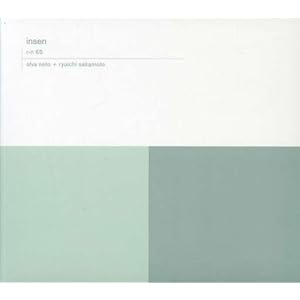
Released in 2005 by Carsten Nicolai, better known as Alva Noto, in collaboration with pianist Ryuichi Sakamoto, Insen is the second album in an ongoing series by the duo. Alva Noto has to date released a total of 45 albums under various aliases since his 1996 debut 'spin.' This album however presents an intriguing marriage of ambient piano technique with Noto's distinctive Glitch Electronica composition.


Texturally, most of the album is quite minimal but with Noto's extensive treatment of piano to create grooves, sustains and even percussive rhythms, the album remains a highly credible work. Stylistically, the approach to composition features typical glitch technique but lacks the pace of much Noto material previously released and presents a series of 7 tracks, a total of 43 minutes, of intriguing pseudo-Ambient material.

In a way, for the attentive listener, the minimal instrumentation presents a slight tedium. For this reason, the 4th track, 'Moon,' deserves a special mention for its textural variety and construction of new additional timbres from Sakamoto's piano playing. Much of the album must be considered a complete work rather than a series of tracks, given the fantastic development throughout from its early minimal ambient beginnings to the more notable integration of glitch elements seen in 'Iano' and the highly processed sombre ending, 'Avaol.'

For a review of Noto's later 'Unitxt' album, click here.
Save on Delicious